

In the extremely unlikely event I were ever to be asked to subtitle this book, I might well say: ‘The Lost Dream of a Sacred Civilisation’.
For this is not so much a book about the Devotion to the Sacred Heart of Jesus per se – as it is the history of a forgotten politico-religious counter-culture of resistance to Republican France.
In any event, the book already has a subtitle – and it is a striking one: ‘An Epic Tale for Modern Times’ It is a mysterious subtitle indeed and one which Jonas never explains.
Now, the ‘epic’ part is clear – this is the little-told story (at least in English) of the Catholic resistance to the values of the French Revolution.
It entails a grand sweeping saga of the vast numbers of French who had no wish to be ‘liberated’ from the ancien régime of Church, Monarch and nobility.
It is the story, then, of the French who preferred piety to rationalism, who preferred the ‘rights of God’ to the ‘rights of man’, who preferred the vision of a Sacred Culture united to God through the Church to a “Godless republic” that must have appeared by turns, soulless, meaningless, dry, devoid of riches – not to say, demonic and evil.
Thus, it is the story of two Frances. The France of the Revolution, which aspired to liberate the poor, oppressed and starving, that aspired to ‘Liberty, Equality and Fraternity” – through massacre. (For when one includes those who died in the counter-revolutionary wars, the numbers, by some estimates, run into hundreds of thousands).
One is even tempted to use the word ‘genocide’ – with all the implications that word has for the eliminating a specific group of people: pious and traditional Catholics, peasants and nobility alike.
But perhaps to say ‘genocide’ is to go too far. Because in many cases at least, this ‘Republic of Liberty’ was content to merely suppress and control, rather than massacre … though massacre there undoubtedly was.
Be that as it may, this is the story of how the France of the Republic succeeded over centuries in crushing the Other France – whose advocates called themselves La Vraie France – the True France.
And Jonas’ book makes lucidly clear the emergence of the bitter conflict between the two during the Revolution. Tout le Monde has heard of the murder of the King Louis XVI and the Queen Marie Antionette.
Yet Jonas brings to the fore the many other lesser-known factors which tore French society in half: the Republic’s expropriation of Church property to fund the State; the often bloody attempt to impose “the cult of reason”; the elimination of monasteries and convents that did not serve ends verifiable by “reason”.
Yes, here Jonas recalls once more to memory, the decisive influence of Talleyrand, who:
was implacable in his utilitarian logic with respect to contemplative orders whose main products were meditation and prayer [affirming that] the nation has the right to “destroy” certain orders “if it judges them harmful or simply without purpose.

Yes, the ‘epic’ part is clear enough. But why, WHY is it that Jonas implies relevance for modern times? This would make sense if Jonas were perhaps a traditional Catholic or Monarchist, who believed in the values of the Other France, who believed her values still had pertinence today.
But Jonas is no such Traditionalist. His perspective is that of a contemporary academic historian, with all the non-faith bias and so-called “objectivity” that usually implies.
This is, in other words, a book to make any traditional Catholic reader wince at times, if not throw down the book in rage. To simply write this book off however, would be a shame indeed.
Though as a Catholic in love with the tradition myself, I can commiserate. A telling of this history stripped of faith is not to become objective, it is to become first lopsided and then cynical …
Now, this is NOT to say that this is an aggressively cynical book, one where Jonas takes up the cudgels for the Revolution. Rather, one senses sense Jonas may even has a certain sympathy for his subjects.
To be fair to him, I think he is genuinely trying to penetrate the motivations and worldview of the Other France.
It’s just that as a sceptic, he can’t.
Jonas, for example, evokes a long, long line of often forgotten saints, visionaries and leaders who stood for the Sacred Heart.
He evokes not simply the relatively well known and canonised Saints, such as St. Margaret Mary Alacoque and St. Claude La Colombiere, but also for example, la venérable Anne-Madeleine Rémuzat, St. Sophie Barat, Marie de Jesus and more, whose often literal visions of the Sacré Coeur helped forged the counter-culture to the Republic.
But how can Jonas hope to penetrate the vision of such mystics, with a view that is basically reductionist, often Freudian?
Thus, Jonas speaks of one Catholic leader not being able to resist a Freudian “internalised” sense of duty. But what if that which is irresistible, is not to be reduced to infantile experience – but is something altogether transcendent to it?
For Jonas there can be no answer. And also no way to discriminate between authentic mystical experience and false. Who can say how much authentic mystical experience forged the counter-culture of the Sacred Heart and how much false … ?
In a similar vein, Jonas while speaking of a vision by which Claude Colombiere came to be regarded as a saint writes: “Within the space of a lifetime, Colombiere had moved from the status of an ordinary mortal with ordinary human failings to a prominent place in a heavenly inner circle. This was an unparallelled triumph.”
But how is Jonas so sure that Saint Claude La Colombiere was never anything more than an “ordinary mortal with ordinary human failings”. Yes by what authority does Jonas assert this view?
Clearly, the “authority” Jonas relies on is a consensus of the reductionist academic zeitgeist, but such can have no authority for the man or woman of faith and piety, who has no trust in the ex cathedra dogmas of Freud …
Yet if Jonas cannot penetrate the spiritual vision of the Catholic mystics, he can still address the social and political attitudes of Catholic France.
Often he does this very well indeed. For example, commenting on the Society of the Sacred Heart of Tournely, Broglie and Varin, Jonas does well in representing their “awareness of the broader cultural implications of 1789” noting that they:
had grasped something essential about the Revolution. For the Revolution and its values to prevail, it would have to drive Catholicism and its values from their leading position in public life.
Well said indeed.
Yes, there is a degree of genuine good intention in this book – which should not be overlooked. It is just that Jonas cannot seem to escape the secular assumptions and modern interpretations of his age. I trust that some of these will seem quaint indeed in time to come.

But if Jonas participates in the modern malady that robs our world of soul and mystery, he is not to be blamed for it. He deserves commiseration instead.
Thus while regretting what the author misses, Catholics can still salute what is on offer. For there is GOLD here. Jonas has done a wealth, a great wealth of intensive research in uncovering an important story – and a story that has rarely if ever been collected under two covers of an English book before.
What is more, the writing is also superb: it is not only highly engaging – I found the book rivetting in fact – but also clear and precise. Sometimes I found Jonas’ turn of phrase most elegant indeed, as if he could not have more sparingly chosen better words to neatly, so neatly capture exactly what he wanted to say.
May I be forgiven for repeating myself? Why is it again I wonder, that Jonas calls his book an Epic Tale for Modern Times?



Foreword for Monarchy by Roger Buck
And I wonder what indeed has moved him to work so diligently at evoking this lost world of soul and tradition and Holy and unholy mystery?
Why has Jonas crafted this Epic Tale … the Epic Tale of the Other France – the France that did not rally to the Revolution, the massacre of king, queen, untold numbers of nobility, priests, monks, nuns and Catholic peasants?
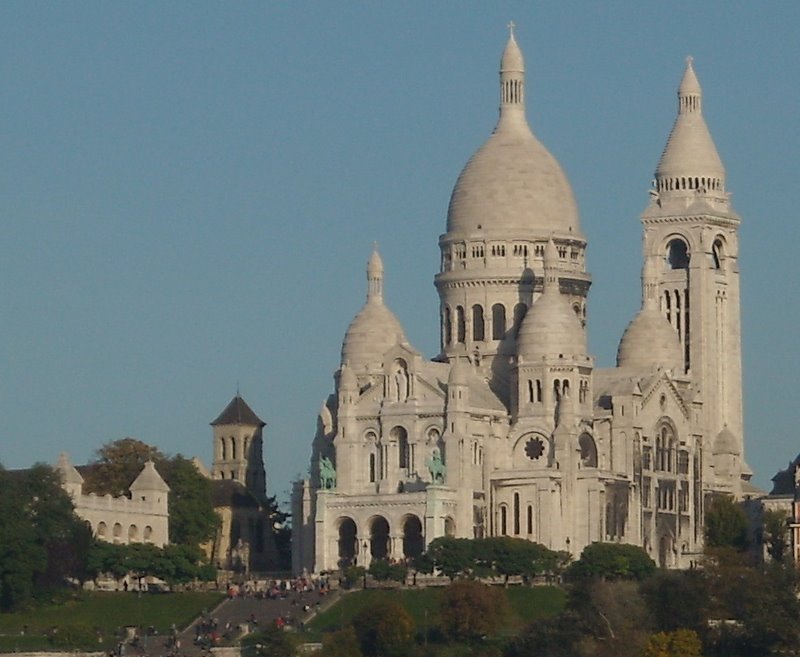
And the France that made continuing efforts to make render visible an alternative vision of a Sacred Culture, most spectacularly of all, on top of a hill overlooking Paris … the Sacré Coeur de Montmartre.
Yes this sceptic Jonas, apparently unquestioning product of a modern age, has spent years of his life in writing and researching this book (as well as a follow-up on Claire Ferchaud, reviewed here), years turning his attention to such a different world than our own. The buried, bygone world of Catholic France before the first World War. And this world of La Vraie France obviously fascinates and compels him.
Speaking very personally, I wonder if somewhere deep within the recesses of his heart, Dr Jonas has a hunger for the Catholic Mystery, which his superb rational mind cannot bear to admit …



My Two-Part EWTN Interview
Buying Books at Amazon Through These Links Gives Us a Commission. This Supports Our Apostolate. Thank You if You Can Help Us Like This!
Comments
comments are currently closed
26 responses to “France and the Cult of the Sacred Heart by Raymond Jonas (Review)”
This book immediately brings to mind Obama’s notorious gaffe in Pennsylvania: \[when communities have not regenerated it’s not surprising that] they cling to their guns or religion . . .\
This is why Jonas considers the losers — the Catholics — in the 18th and 19th century French culture wars a tale for modern times.
Though he never compares 18th century France to 20th century America, Jonas casts the French Catholics as exactly that — clinging to their guns and religion.
I can’t help but think that Jonas uses the political failure of the French Catholics as a sort of assurance to his peers that the Religious Right will, like the French devotion to the Sacred Heart, fall into cultural irrelevance.
Whimsy – thank you!
This is a very interesting “take” on this, which didn’t occur to me, far removed as I am from America’s culture wars.
I think you may have a real point here. And at the same time, I feel there could be more as well. For in both this book, and his later one on Claire Ferchaud, Jonas it seems to me has a strange fascination for his subject matter. As though he is genuinely interested, even drawn to his subject – even if he might not be able to bear to admit it!
Again though, a very interesting comment, I will definitely be bearing in mind …
[…] For it is a story that lies behind much of the inspiration for this website and which Kim and I will be exploring more in time. But a beginning at least has already been made in places like this. […]
[…] https://corjesusacratissimum.org/2009/05/book-review-france-and-the-cult-of-the-sacred-heart-raymond-… This entry was posted in Roger's Weblog and tagged Catholic France, Catholic Mystery, Catholic […]
[…] Alternatively, readers might like to begin with the author’s previous book, which so powerfully evokes this lost world: France and the Cult of the Sacred Heart, which I have also reviewed here. […]
[…] Unfortunately, I find it necessary to grapple with such books. For instance, something that has been enormously helpful to me is an admittedly Freudian, reductionist, faithless text entitled France and the Cult of the Sacred Heart. […]
[…] Empire, Life of St M.M., This is the Faith, Marian Apparitions, The Secret of the Rosary, France and the Cult of the Sacred Heart This entry was posted in Reviews and tagged Tradition Resurging. Bookmark the permalink. Post a […]
[…] Empire, Life of St M.M., This is the Faith, Marian Apparitions, The Secret of the Rosary, France and the Cult of the Sacred Heart This entry was posted in Kim's Weblog and tagged Our Lady, Rosary. Bookmark the permalink. Post a […]
[…] Empire, Life of St M.M., This is the Faith, Marian Apparitions, The Secret of the Rosary, France and the Cult of the Sacred Heart This entry was posted in Roger's Weblog and tagged Church in Crisis, Liturgy and Sacraments, […]
[…] Links to each Review here: Heart of the Redeemer, Meditations on the Tarot, Puritan’s Empire, Life of St M.M., This is the Faith, Marian Apparitions, The Secret of the Rosary, France and the Cult of the Sacred Heart […]
[…] last is important to this website. We have invoked it many times (e.g. here) and we wish to do far more to explore it in the […]
[…] Empire, Life of St M.M., This is the Faith, Marian Apparitions, The Secret of the Rosary, France and the Cult of the Sacred Heart /* This entry was posted in Roger's Weblog and tagged New Age, Tradition Resurging, Valentin […]
[…] St Margaret Mary Alacoque), (This is the Faith), (Marian Apparitions), (The Secret of the Rosary), (France and the Cult of the Sacred Heart). /* This entry was posted in Roger's Weblog and tagged New Age, Personal/Autobiography – […]
[…] St Margaret Mary Alacoque), (This is the Faith), (Marian Apparitions), (The Secret of the Rosary), (France and the Cult of the Sacred Heart) (The Power and the Glory). /* This entry was posted in Roger's Weblog and tagged New Age. […]
[…] These titles can also be found in our Amazon UK store here. There is also a review for each book at these links here: (Heart of the Redeemer) (The Life of Saint Margaret Mary Alacoque) (The Autobiography of Saint Margaret Mary) (France and the Cult of the Sacred Heart) […]
[…] Cor Jesu Sacratissimum HomeAbout UsKim's WeblogRoger's WeblogWebburstsReviewsIn MemoryArticlesUK StoreUS Store « Where Have I Come From? A Touch of Biography … Book Review: France and the Cult of the Sacred Heart – Raymond Jonas » […]
big like! – thanks .
It’s relevance to modern times has to with the present rise in the “faith” based paradigm strongly emergent in evangelical America, neo-orthodox Russia, radicalised Islam not to speak of neo-conservatism in France herself. The beastial side of Voltaire is predominant to some even in modern times.
[…] St Margaret Mary Alacoque), (This is the Faith), (Marian Apparitions), (The Secret of the Rosary), (France and the Cult of the Sacred Heart) (The Power and the Glory). /* This entry was posted in Roger's Weblog. Bookmark the permalink. […]
[…] St Margaret Mary Alacoque), (This is the Faith), (Marian Apparitions), (The Secret of the Rosary), (France and the Cult of the Sacred Heart) (The Power and the Glory). /* This entry was posted in Roger's Weblog. Bookmark the permalink. […]
[…] These titles can also be found in our Amazon UK store here. There is also a review for each book at these links here: (Heart of the Redeemer) (The Life of Saint Margaret Mary Alacoque) (The Autobiography of Saint Margaret Mary) (France and the Cult of the Sacred Heart) […]
[…] These titles can also be found in our Amazon UK store here. There is also a review for each book at these links here: (Heart of the Redeemer) (The Life of Saint Margaret Mary Alacoque) (The Autobiography of Saint Margaret Mary) (France and the Cult of the Sacred Heart) […]
[…] Links to each Review here: (Heart of the Redeemer) (Meditations on the Tarot), (Puritan’s Empire), (Life of St Margaret Mary Alacoque), (This is the Faith), (Marian Apparitions), (The Secret of the Rosary), (France and the Cult of the Sacred Heart). […]
[…] Links to each Review here: Heart of the Redeemer, Meditations on the Tarot, Puritan’s Empire, Life of St M.M., This is the Faith, Marian Apparitions, The Secret of the Rosary, France and the Cult of the Sacred Heart […]
[…] These titles can also be found in our Amazon UK store here. There is also a review for each book at these links here: (Heart of the Redeemer) (The Life of Saint Margaret Mary Alacoque) (The Autobiography of Saint Margaret Mary) (France and the Cult of the Sacred Heart) […]
[…] Links to each Review here: (Heart of the Redeemer), (Meditations on the Tarot,) (Puritan’s Empire), (Life of St M.M.), (This is the Faith), Marian Apparitions, The Secret of the Rosary, France and the Cult of the Sacred Heart […]
[…] example, I have reviewed in depth Jonas’ France and the Cult of the Sacred Heart. Here is a book from the secular liberal academia of modernity. How frequently it reduces the […]