
As I said in a comment to my last entry, I felt very, very heartened by a comment from Aaron here.
In a departure from my usual, slightly more formal approach, I want to use this space to engage with your thinking, Aaron.
First, I’d like to quote you – albeit with some editing. The editing is not because I dislike anything, but because I want to emphasise certain important observations you make:
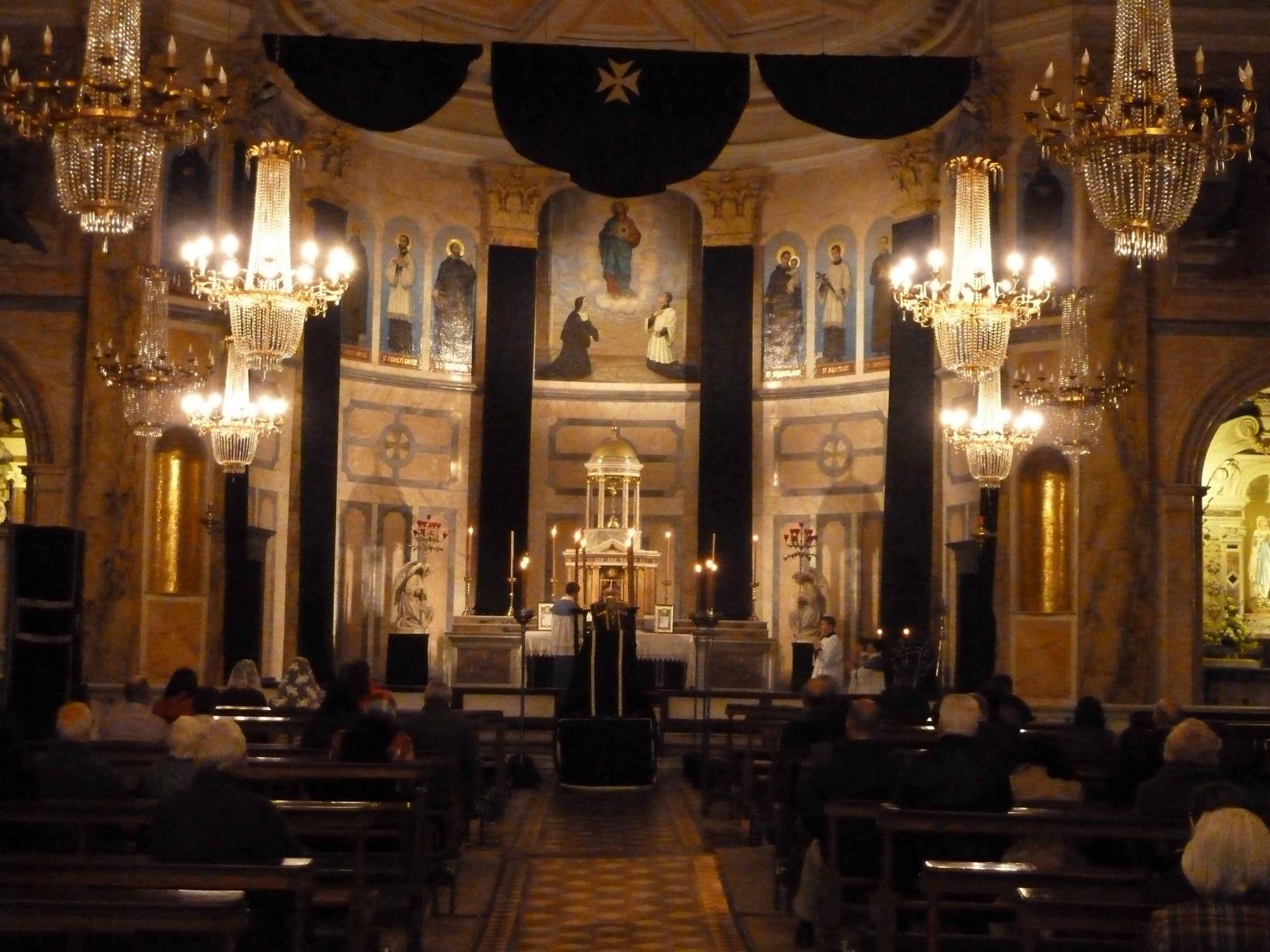
About half the New Agers I know are former Catholics, but the Catholicism they tasted was probably as bland as the Protestantism you mention. In the 70s and 80s … we went to a Mass where Christ came down to our level, so there was little Mystery to be had.
It’s not surprising that people drifted away looking for something more meaningful and coherent, but somewhat ironic that they drifted into a belief system where meaningfulness is almost suspect by definition. By trying to embrace everything, they wind up embracing nothing—nothing except the self, perhaps.
I find that these are generally very intelligent, caring people who are searching for something; … They read voraciously, looking for answers to the meaning of life, but mostly from one shelf of books written in the last century plus a few older Gnostic tomes …
Every term they use, like “Spirit” or “Christ,” was taken from the Church and then stripped of meaning until it had nothing left to offend—or illuminate.
Well, not quite “every term”, Aaron.
There are Eastern terms aplenty! But apart from such quibbles, I feel there are very acute observations in what you write. Moreover I feel they are of burning importance.
First, the liturgy is a catastrophe and whether we belong to those who want the restoration of the Latin Mass or those who want a “Reform of the Reform” – a restoration of Mystery to the new Mass in the vernacular, it is disheartening that so few sense or care about all that is being lost and destroyed.
Moreover I do believe much of the power of the New Age movement lies in a reaction to a Christianity stripped of Mystery. As I come to, this I think is usually Protestant …
For it was striking to me, living in Findhorn, seeing thousands upon thousands of people come through ever year, how many were from what we might call cultures stemming from Northern Europe.
Findhorn prided itself on being “international”, but the French, the Spanish, the Italians for example, were hardly present at all.
Aaron you also write: “one shelf of books written in the last century” … Yes indeed. And this is also very predominantly an Anglophone stream of books.
Helena Petrovna Blavatsky was a Russian who came to write The Secret Doctrine – a very major font for those books – in English in 1888, at a time when English was not the world-conquering language that it is today. (For other readers of my site, it is not insignificant in this context, that another Russian, who never lived in France or any Francophone country, deliberately chose to write his book on the Catholic Mystery in French).
In my book, I maintain that New Age-ism – far from being universal – is much more culturally bound to Anglophone Protestant heritage than is usually observed.
Though I fully take your point, Aaron, that where a bland, Protestantised Catholicism has arisen, the results can be the same. There is much in my book which echoes your thoughts above and although I wasn’t planning on quoting from it again, I can’t resist throwing into the pot another extract from my draft-in-progress:
“There is a vast group of people in the West today, who are disillusioned from the materialistic culture, that I have begun to paint. This collective experiences real spiritual hunger and yet they are also disenchanted with organised religion.
Or at least, they are disenchanted with their preconceived images of institutionalised religion. For in matter of fact, a great many of these people have never even had significant experience of any organised religion! They react to the institution of religion and confidently proclaim that such institutions are passé now and only limit one’s experience.
Being often barely acquainted at all with a religious path, they do not realise that the institutions of the Church rather than being a limitation, can be a gateway to something they have never known. Thus in many cases their judgment about religion is not based on reality, but on images that are superficial or incomplete indeed.
Now the images which they react to, are usually and naturally those of Christianity. (And more specifically I wager, Protestant Christianity. Though in some cases it may well be a Protestantised Catholicism that is so “reformed” that it can often now appear nigh indistinguishable from Reformation Christianity, itself.)
This New Age approach formed in reaction to these images, frequently espouses the notion that it represents one vast and universal spirituality.
Yes, although it frequently disclaims any unifying ideology or set of doctrines, here is one doctrine that one will find repeated right across the spectrum of New Age thinking: Beyond the manifold, divided and divisive all-too-human religions, there is but a single spirituality which, the more one transcends the narrowness of the individual creeds, the more one approaches.
According to this idea, religions like Christianity thus serve to obscure this true universal spirituality, because they are time and culture-bound.
The New Age however rarely if ever see its own brand of spirituality as every bit as culture-bound – or indeed more so. Its adherents frequently suppose frequently suppose that the New Age spirituality of the twenty-first century somehow represents a perennial core to all forms of spirituality that have ever existed and at which they have have arrived, now that they have transcended limited religion.
Or at any rate, something like that is what I once supposed myself, never imagining that the New Age spirituality I passionately advocated might actually be far more time and culture bound than any of the great religions.
It never occurred to me that these claims were being made in and from a very specific slice of time and space. One would not go too far wrong, I think, in saying the North Atlantic secularised cultures in the aftermath of the 1960’s. Above all: England and America.
And back at Findhorn, if anyone had said to me Catholicism was more universal – in both time and space – than New Age-ism, I might have laughed …”
I will stop for now – with a final personal comment to you, Aaron. I have not commented on everything you say. But there is still more going on within me in response to other things you raise. Your post has been REVERBERATING in me for 48 hours now and helping me …
Foreword for Monarchy by Roger Buck
Buying Books at Amazon Through These Links Gives Us a Commission. This Supports Our Apostolate. Thank You if You Can Help Us Like This!
Comments
comments are currently closed
11 responses to “Bound in Time and Culture: The ‘Universal’ New Age”
Roger, I’m finally getting around to commenting on this. I’m glad you found my comment useful, and wanted to take some time with my reply. You make a very good point here about New Age being culture-bound. I hadn’t thought of that, since I’ve only experienced one culture myself, but I suspect you’re right. I would add that I think it (at least the version I’m familiar with) also requires that the culture be fairly prosperous. Especially the “prosperity gospel” and “manifest the life you want” angles. I suspect that the general prosperity in the West for the past 50 years has contributed greatly to the spread of New Age beliefs, and they wouldn’t survive poverty very well.
Recently I heard a New Ager talking about his visit to a Greek Orthodox Mass. He thought it was beautiful, but was somewhat disdainful of how “ritualistic” it was. The implication seemed to be that ritual is okay as a sort of entry-level religiosity, but more enlightened people leave that behind. But he’d never use the word “ritual” to refer to a group of people chanting mantras around a crystal or doing yoga, simply because those things aren’t traditional. If you mix and match rituals and pick out the ones you like by your own choice, that’s not “ritualistic” somehow. It’d be more honest to simply accept the human need for ritual and recognize that all faiths use it.
Aaron – there’s a great deal here and I really thank you for it. Regarding your prosperity point. This is how things appear to me, controversial though I know they are. New Age-ism thrives both in prosperity cultures as you say and as I said, cultures of Protestant heritage. And there are connexions between all of these.
New Age-ism is in some ways Protestantism pushed to its final extreme. Protestantism encouraged individual experience and belief at the expense of 1400 years of Tradition. That is, although the first hundred years or so – roughly the epoch of the New Testament – continued to be held with profound and due reverence, the next 1400 years until Luther were in so many ways – though not always and not everywhere – but still in so many ways, dismissed, mocked or at least greatly relativised.
New Age-ism completes the course. Now everything can be thrown into the dustbin of history.
This may sound bitter, but I do not want to become bitter. The attitude I pray for is one that is not bitter but SOLEMN. Something very tragic is going on and I would like my attitude to be as that of a hospital worker in a warzone: No time for bitterness.
To return to my point. This prosperity consciousness also thrived in a Calvinist context where wealth was actually seen as Sacramental: A visible sign of God’s invisible presence …
And there has been a great deal of criticism over the centuries by Protestants of “backwards” less economically proficient Catholic cultures. Today we can look at the EU crisis and this PIGS acronym [!] – Portugal Ireland Greece Spain and note that not one of them is a Protestant culture …
I have a book review going up soon that expands on this a little.
As for your point about ritual. Yes indeed. And there is a powerful New Age ideology that anything associated with traditional religion is “retrograde”. Not in line with the myth of progress and evolution forward. As you well observe, something that “more enlightened” folk bypass.
I do not know the New Ager of whom you speak of course. But I cannot help but wonder – did his heart feel the beauty, but his head was so much in the grip of New Age ideology that the voice of his heart was drowned out …?
Again Aaron I am very heartened to hear of your acute engagement with these solemn matters.
A related book I found interesting is Bright-Sided, by Barbara Ehrenreich. She’s an atheist, so her viewpoint is limited by that. But she talks about how the positive thinking movement began in the 1800s as a reaction to the depressing fatalism of Calvinism, and then New Age and the consumer culture both took it to extremes in recent decades. It’s a shame that she completely misses Catholicism, which presents the Hope that falls between those two extremes; but her experiences with and investigation of the positive thinking movement are enlightening. I hadn’t realized how much it had influenced modern society, and even my own thinking, until I read that book.
Aaron – wow! I went to Amazon and this book does look extraordinarily interesting and relevant to so much I want to explore at this site and in my book. So relevant in fact that I am going to quote the Editorial Review from Amazon:
“Ehrenreich (Nickel and Dimed) delivers a trenchant look into the burgeoning business of positive thinking. A bout with breast cancer puts the author face to face with this new breed of frenetic positive thinking promoted by everyone from scientists to gurus and activists.
Chided for her anger and distress by doctors and fellow cancer patients and survivors, Ehrenreich explores the insistence upon optimism as a cultural and national trait, discovering its symbiotic relationship with American capitalism and how poverty, obesity, unemployment and relationship problems are being marketed as obstacles that can be overcome with the right (read: positive) mindset.
Building on Max Weber’s insights into the relationship between Calvinism and capitalism, Ehrenreich sees the dark roots of positive thinking emerging from 19th-century religious movements. Mary Baker Eddy, William James and Norman Vincent Peale paved the path for today’s secular $9.6 billion self-improvement industry and positive psychology institutes.
The author concludes by suggesting that the bungled invasion of Iraq and current economic mess may be intricately tied to this reckless national penchant for self-delusion and a lack of anxious vigilance, necessary to societal survival.”
A lot here I think! The American Mary Baker Eddy’s Christian Science it seems to me is another Anglophone precursor to A Course in Miracles and so much New Age Gnostic reworking of Christianity to deny the Incarnation.
And Max Weber of course is also the atheist author of The Spirit of Capitalism and the Protestant Work Ethic – in which this clearly non-Catholic sociologist roots capitalism in the Reformation …
Very, very interesting indeed.
Aaron you write:
“It’s a shame that she completely misses Catholicism, which presents the Hope that falls between those two extremes.”
Indeed – and what is more is that in the English speaking world in general (Ireland being the most notable exception) a Calvinist conception of Christianity has become so ingrained that not just Ehrenreich, but so many “completely miss” the point of Catholicism, the very different point … Certainly I did for 34 years!
But this last point came home to me very powerfully at an Anglican college in Britain where Kim and I studied theology. Kim and I were the only Catholics on the course and again and again, we would hear Protestant doctrine continually presented as Christian doctrine – completely missing the point that at least 65 per cent of global Christianity was saying something different.
Either out loud or in my head, I found myself saying to my tutors “Er, excuse me – this isn’t what either Catholicism or Orthodoxy teaches. At least 65 per cent of global Christianity is saying something very different and you hardly seem to realise …”
Again: Culture-bound!
Houses and cars are quite expensive and not everybody can buy it. However, business loans was invented to help different people in such kind of situations.
Yes indeed Leona. Not everyone can afford such things. Probably more than ninety five per cent of the world, in fact.
And I believe I will permit your little spam here as testimony to a world seeking to grip and enslave. Debt of course enslaves entire populations of whole countries who cannot afford.
I do not know what your company lowest rate loans is, but may I confess that I often associate companies with such names as those seeking to enslave …
Certainly placing such spam in a blog like this does not inspire my confidence!
[…] Ripping such a fragment out of context is tricky business. There are references below, which may make little sense. It may help, if I say explain that my book explores the Theosophical origins of the New Age movement and how its depersonalised yet supposedly universal philosophy stands in sharp contrast to Catholicism. You can read a little that is relevant here, if you like. […]
[…] Bound in Time and Space: the “Universal” New Age […]
[…] For once again: New Agers are much more likely to have Protestant roots than Catholic ones. And if they do have any experience of the Catholic faith, it is almost certainly a highly-Protestantised version of modern Catholicism. […]
[…] It is above all an Anglo-American phenomenon. (See, for example, here and also here.) […]
[…] For once again: New Agers are much more likely to have Protestant roots than Catholic ones. And if they do have any experience of the Catholic faith, it is almost certainly a highly-Protestantised version of modern Catholicism. […]