
For centuries now, our world has been increasingly filled by purely humanistic culture. And the majority of what we regard as great literature turns on very worldly themes. In the novels of Jane Austen or E. M. Forster, for instance, we do not have profound explorations of Divine Grace in our lives, nor matters of the Faith.
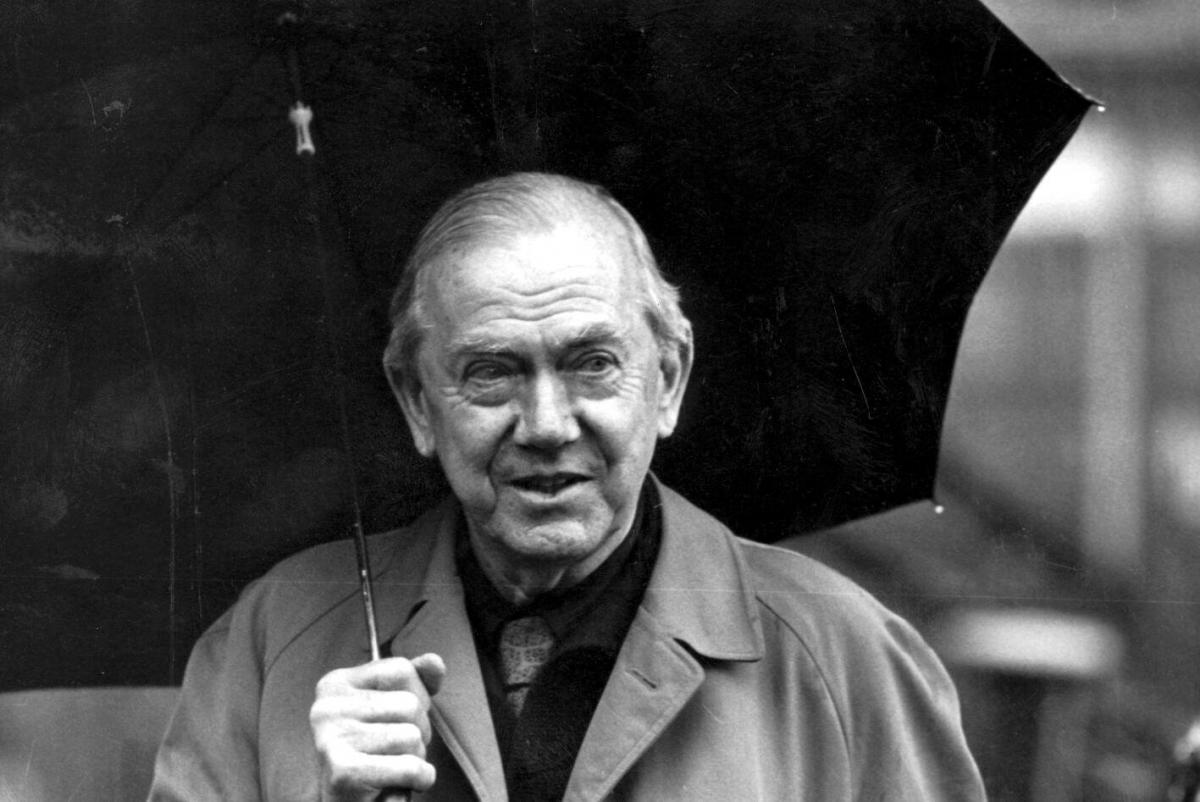
But from late 1930’s till the 1950’s, a notable exception to this trend could be found in the Catholic novels by one of the great literary figures of the last century: Graham Greene. I have already reviewed his 1940 masterpiece The Power and the Glory here at this site.
Monsignor Quixote is a much, much later novel. Some traditional Catholics might question my approbation of this work. For after the early great Catholic novels, Greene appeared to lose his faith. This late novel is quite different then, and contains what could appear, superficially, as little but sarcastic liberal jibes against the Faith.
I have also heard it remarked that with his loss of faith, the power of Greene’s novels diminished.
Now, I will not deny that compared to The Power and The Glory, Monsignor Quixote is lacking. Yet The Power and the Glory is the most important and mighty novel this writer has ever read.
Compared to the towering insight and depths of pathos of that tour de-force, much (if not all!) of Monsignor Quixote is like a gentle, comedic stroll. But how much do such comparisons matter? Must Shakespeare produce a Hamlet every time he steps up to the bat?
For if Monsignor Quixote is not on the same niveau as The Power and the Glory – it is also very far from lacking merit.
It is perhaps unfortunate then, that Monsignor Quixote invites comparison to the earlier masterpiece – for it contains certain muted echoes of that book. There, the leading characters are an alcoholic Mexican priest hunted for his life by a Communist officer bent on eradicating all the priests. Here, the setting is immediate post-Franco Spain and the protagonists are an unlikely Monsignor and a Communist Mayor who are also being hunted.
What results is a series of misadventures – comic, tragic and studded with gems. The Monsignor emerges with a piercing, genuine sweetness that perhaps only a great novelist like Greene could render. (With lesser talents, the result could easily have been cloying.) But here we find real human beauty in an inept yet noble priest enamoured of St. Francis de Sales and St. Therese de Lisieux. The Communist of course, is devoted to Marx and Lenin, though, like most Spaniards, he had once been a practising Catholic …
The two of course represent the different sides of the 1936-39 Spanish Civil War and the Spanish dedication and passion for these very different ideals may surprise. At least, my experience of the Anglo-American sphere, is that we British and Americans are often not used to meeting serious proponents of either such Catholicism or Communism …
I will not deny that there are sarcastic “Communist” and liberal passages here that dismay me. I warn those who are faithful that there is material here, which may offend what they know to be true in their hearts. Still those like myself can gain understanding and insight into a very different world – which is no bad thing.
Some might even see in this late novel a rejection of Faith – but I do not think so. In fact, I think there is evidence here, that Greene may be slowly recovering his earlier faith – albeit in a tortured way which, filled as it is with doubt and paradox, is perhaps all-the-more heroic.
Faith – the real meaning of that word is indeed key to this book. And on this theme, there is a JEWEL so precious here that it merits quoting in full. In the novel, the Monsignor becomes deeply disturbed by a nightmare:
Sleep continued to escape him, while the terrible dream of his siesta stayed with him like a cheap tune in the head.
He had dreamt that Christ had been saved from the Cross by the legion of angels to which on an earlier occasion the Devil had told Him that he could appeal.
So there was no final agony, no heavy stone which had to be rolled away, no discovery of an empty tomb. Father Quixote stood there watching on Golgotha as Christ stepped down from the Cross triumphant and acclaimed.
The Roman soldiers, even the centurion, knelt in His honor, and the people of Jerusalem poured up the hill to worship Him. The disciples clustered happily around. His mother smiled through her tears of joy.
There was no ambiguity, no room for doubt and no room for faith at all. The whole world knew with certainty that Christ was the Son of God.
It was only a dream . . . but nonetheless Father Quixote had felt on waking the chill of despair felt by a man who realizes suddenly that he has taken up a profession which is of use to no one, who must continue to live in a kind of Saharan desert without doubt or faith, where everyone is certain that the same belief is true.
He had found himself whispering: God save me from such a belief.
Then, there is a mysterious, haunting and paradoxical ending. A reviewer should not reveal too much and Greene has left it so ambiguous, as to elude any certain interpretation. But perhaps I may be permitted to offer my own hermeneutic: Greene seems to be saying that the Marxist atheist has received his first Sacrament in thirty years. And after this, he no longer has the “freedom” of complete disbelief.
He has been transformed by Grace via the Sacrament and, after decades, Graham Greene is writing – once again – about the Power of the Catholic Mystery …

*****
This for me is the final, most definitive joy in Monsignor Quixote – and I am tempted to end my review on that note.
But some final remarks: If you are a native Anglophone like myself, dear Reader, your world will likely have been dominated by Anglo-American literature, films and so forth. Greene was English, true. But he gravitated to Catholic cultures. Much of his literary life was spent in France. And he came to know Spain very well through significant travel and profound friendship there.
Thus in this English book, we have an acute observation of a very different cultural-matrix than many of us know. It is a world where people have vastly different aspirations to that of the capitalism which has dominated the Anglo-American sphere, particularly in recent decades.
In this world you will not meet many people obsessed with fashion, gadgets, prosperity-consciousness, keeping ahead of the Jones’ or being a winner and not a loser. But you will encounter characters whose lives are dedicated to the “Workers of the World United in the Party” as well as people agonised about the Church.
In short here is a world of Spain circa 1980, yet very foreign to the increasingly Anglo-Americanised world of 2010. It is a world in which all kinds of ordinary people take either Catholicism or Marxism very seriously – and in this novel meet in strange and surprising ways.
I write these lines as an American living in Madrid. Travel has allowed me to break through some of my cultural inheritance and I am blessed indeed. Not all have the same Providential destiny as myself—but many I think could benefit from such a sharp observer as Graham Greene in looking beyond the horizons of their culture.
For this reason alone, I would recommend Monsignor Quixote. And in these days of the Internet and Wikipedia, one can, if one wishes, easily take this novel, look up the cultural references which may not be familiar and enter into a very different universe …
I consider myself very fortunate to have come to know firsthand this precious universe – at least a little. The livingness of Spanish Catholicism moves me very deeply and I have been given vital insights difficult to find elsewhere.
Such is my own destiny and may not be yours, dear Lector. But if this world should speak to you, you could do much worse than let Graham Greene be your guide for a short while …
Foreword for Monarchy by Roger Buck
Buying Books at Amazon Through These Links Gives Us a Commission. This Supports Our Apostolate. Thank You if You Can Help Us Like This!
Comments
comments are currently closed
14 responses to “Book Review: Monsignor Quixote by Graham Greene”
[…] Book Review: Monsignor Quixote by Graham Greene […]
[…] Book Review: Monsignor Quixote by Graham Greene […]
Corjesusacratissimum…
[…] something about corjesusacratissimum[…]…
Interesting review. When I read this I picked it up by chance not knowing anything about Greene or that he was a religious writer. I suspect that had I read one of his earlier books (based on what I read of them being highly religious) then I would have thrown it away. The notions of supernatural entities that I had been raised on were dealt their final blow while reading a book on Palestinian archaeology some months earlier and I found the book more or less sympathetic to my position. I do remember one line likening Marxism to Christianity and it did cause me to question whether my somewhat Marxist sociological leanings about the necessary progression of nations through various stages were founded on fact.
Thank you Thomas for commenting! It is always good to get feedback. Now the last thing I want to do is quarrel with anyone kind enough to express interest here.
Yet I must record that I have little idea how Palestinian archaeology could deal a final death blow to notions of supernatural entities.
Much of the rest of this website involves weeping for such a state of affairs in the world and letting the tears of the heart hopefully be transformed into finding creative solutions to what seems to me the central tragedy of the world.
But yes Thomas, I think Greene was sympathetic to your views here “more or less” as you say. He appears to have lost faith for years. He understood well things that I can well imagine you may have honestly struggled with yourself.
But as I said in the review, this is my joy in the book. Greene has been down a dark road indeed. And although he struggles still, and the ending is ambiguous, it suggests strongly the power of the Catholic Mystery and Sacraments to disturb the atheistic faith of the communist mayor and begin to restore him to the faith he once had.
I cannot help but wonder if Greene is seeing his own materialist faith here being disturbed in a similar way to the mayor he writes of and is seeing the faith of his youth being restored.
This mayor seems as though he will be forever changed by the Sacrament he receives at the end of the novel …
And by his encounter with the humble Monsignor Quixote of Faith.
Again I very much appreciate your taking time to comment.
Hi Roger
Not sure if you are still around to respond, I’ve only just now come across this review. I read this book first about 20 years ago and it remains one of my favourites. I have often wondered if Greene intended some sort of allegory here.
Monsignor Quixote is a direct descendent of Don Quixote who never existed. Was this necessary for the story or could it be that Greene was making a veiled comparison with the connection between the Adam of the creation story and Jesus who was a direct descendent of that Adam who never existed.
Harry – thank you for this.
I am still around – though new blog posts will not appear till after Easter, at the earliest.
I have never thought of the allegory you raise and will ponder the next time I re-read this remarkable book. (It’s a favourite of mine too).
Warm thanks again. Despite absence of blog posts, I will now be paying more attention to replies at the site and hope to catch with other responses soon.
I love this book. It appeals to me and intend to use it in a talk I am giving next week.
The talk will start with a copy of Don Quixote and how the writing makes the Man of La Mancha a character study in how a person, I do not believe the Don was insane, can devote self to a belief. I have that kind of a problem with my work,
Monsieur Quixote carries this belief forward by epitomizing Cervantes character into a travel travail to learn more about himself.
The third book will the the Little World of Con Camillo which moves the Monsignieur even more forward in his “battle” with the local communist “friend”.
The thrust of the story is to encourage my group to read more than the newspaper, and try to understand the characters in the books. I discovered this many years ago and continue to go back and read these three books.
“I cannot live without books” Thomas Jefferson as printed on my favourite t-shirt from the Vancouver Public Library.
Thank you Wayne for sharing here your enthusiasm for this very special novel. I cannot comment much more as it sounds as though you may well engaged with this book more than I have!
I have only read it between two and three times. And certainly I have yet to do background reading such as Cervantes’ Don Quixote, which was obviously such a fertile source for Greene in this novel of one of Don Quixote’s “descendants” …
I will say however that while I differ from the unitarian Jefferson on many points, I certainly understand the sentiment on the t-shirt!
Roger, the talk I gave was very well rec’d. Of 8 participants, 6 asked more about the books and are going to read same. I am still searching for the Don Camillo omnibus so as to make my collection more complete.
Thank you again Wayne. In your original comment here, I noted how you spoke regarding an initiative to “encourage my group to read more than the newspaper”. It seems as though you are succeeding!
I think encouraging people beyond the narrow confines of the zeitgeist-soaked media is a very good thing and I see how both Monsignor Quixote and Don Camillo as well as Cervantes can lead people into very rich universes beyond the zeitgeist soaked media. Good luck to you!
a splendid review. this is my favourite of Greene’s novels and believe it is not only a book about faith but also about love – and how it grows after death – perhaps with the grace of the sacrament
Belated gratitude to you Laura for this. And yes the power of love beyond death in the book’s coda and sacramental grace is haunting … especially as it seems as though Greene had lost so much of his faith by this time. Somewhere in his heart, he clearly hadn’t.
[…] Still, I am immensely grateful for the entire series of Greene’s Catholic novels. Brighton Rock forms a dark beginning. More light will break forth as the series proceeds with The Power and the Glory (again reviewed here) and concludes with Monsignor Quixote (reviewed in-depth here). […]