

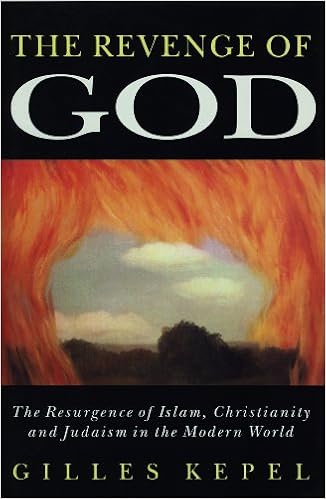
This book was originally published in France in 1991 and remains incredibly topical.
It illustrates better than any book I know, the resurgence of religion the author calls ‘re-Christianisation’, ‘re-Islamicisation’ and ‘re-Judaicisation’.
And it powerfully points out that the views of those who still feel secure in – or dismayed by – the apparent triumph of secular modernity, may be thirty years out of date.
For although in the early 1970’s it seemed that a modern liberal secularism was becoming everywhere more dominant, by the late 1970s, as this book shows clearly, a certain turning of the tide was evident.
Kepel locates his account of this turning in four streams: Protestant and Catholic Christianity, Judaism and Islam.
He begins with the late 70s founding of Jerry Falwell’s Moral Majority, the 1978 election of Pope John Paul II, Begin’s 1977 victory over nearly thirty years of secular Zionism and Khomeini’s 1979 revolution in Iran.
He then goes on to marshal an amazing amount of facts and insights from the following years illustrating a continued activity in these domains to establish cultures that break from secularism in decisive ways and mount challenges to the secularist state.
I give this book praise on numerous accounts. Its subject is incredibly important and still so overlooked in many attempts to understand our contemporary world. Kepel’s accumulation of evidence is prodigious. It is very well written and accessible. Its tone attempts to be balanced and non-polemical. This is not to say that Kepel is without bias – only that there is sincere effort to be fair.
Yet, it is not without serious faults. As the title implies, this is a book of secular bias, which betrays little understanding of the true depth and meaning of religion.
Thus, the book misrepresents aspects of Christianity and no doubt, it also misrepresents Judaism and Islam. As I am not qualified to comment on these latter, however, I will mostly restrict myself to the field of Christianity.
Thus, I will say that a main weakness of Kepel’s account of religious resurgence, is that it is too monolithic, too homogeneous.
He seems to assume that the return to religion, is a more-or-less single phenomenon in response to secularism’s failures, though varying from culture to culture.
However such variations in culture are not sufficient to explain the fact that there is a world of difference between the Ayatollah ordering the execution of Rushdie and the conservative John Paul II advocating – with deep sincerity, I believe – a Church that proposes rather than imposes.
And there is also a world of difference between a kind of Christianity – and I believe Judaism and Islam, as well – that weeps for the entire way secularism degrades humanity and that which focusses on single issues, such as, say, abortion.
Certainly John Paul II waged a heroic battle against abortion too – but his critique of modernity was hardly limited to isolated issues.
It extended to include the entire way modern capitalism and communism debases the human being as a means, not an end, the way our culture of arid commercialism manipulates the desires of millions and the cultural deserts that results from utilitarianism and functionalism.
This kind of extensive critique of secularist, capitalist culture. What can I say? You will not hear such from Jerry Falwell …
My point is that resurgent religion may encompass at least two distinct types of phenomena. Though such a distinction seems lost on Kepel.
On the one hand, there may be a simplistic fundamentalist backlash. On the other hand, a profound meditative seeking for a higher order of values than reductive secularism permits – an order of values that does not permit the tragedies of either laissez-faire capitalism or communism.
Moreover, although Kepel is concerned with the way resurgent fundamentalism can compromise freedom, his approach is not balanced with awareness of the way secularist ideology may do exactly the same – and in some cases more severely.
Yes Kepel seems to hardly note the kind of corporate control of minds which can only be aided and abetted by the lower order of values secularism apparently rests on.
And his only awareness of the tyranny of secularism may unconscious, as when he notes, for example, how the new religious resurgence is ‘an attempt to loosen the grip of secularism’ [Italics mine].
Yes, secularism has a powerful ‘grip’ indeed … all the more effective and insidious, because it manages to disguise itself as ‘value-neutral’.
Whatever my qualms, this book has many, many insights to offer those who feel acutely what the Holy Father has called “the dictatorship of relativism”. Those seeking a way out of its grip will find very much of value in these pages …


Foreword for Monarchy by Roger Buck



Comments
comments are currently closed
One response to “The Revenge of God: The Resurgence of Islam, Christianity and Judaism in the Modern World by Gilles Kepel (Review)”
[…] seventies. To understand this, I would highly recommend a 1991 secular denunciation: Kepel’s The Revenge of God (which I’ve also reviewed here). Although Kepel’s is a secular book I strongly disagree […]