
2023 Preface: Looking Back to 2009:
Dear Lector,
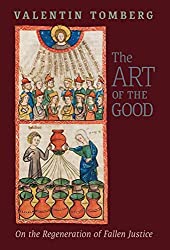
Below you will find the first of a series of four posts from 2009. These concern my first encounter, fourteen years ago, with Valentin Tomberg’s astonishing works on jurisprudence, the first of which has (at last!) been made widely available in English as The Art of the Good (and which I have reviewed here).
It may help to clarify things in this four part series, if we point out that 1944 book’s original title was Degeneration and Regeneration of Jurisprudence—and that it signalled an astonishing break from Tomberg’s Anthroposophical past.
It also seems helpful to list this four-part 2009 series with links—as well as two much more recent related posts—as this may further serve to clarify matters, matters which are not only extraordinarily important for us at this website, but we believe for the very future of the West.
Thus, we list:
First Part: The Moral Oxygen of Valentin Tomberg
Second Part: Stunning New Vistas—Valentin Tomberg’s Catholic Jurisprudence
Third Part: One Must Have Courage to Recognise the Fatal Tree
Fourth Part: Tomberg turns to the LIFE of the Church …
Related Entries:
We pray the various Tomberg videos featured on all these pages may also help to illumine these extraordinary things. And now back to my former self, writing in 2009—Roger Buck
2009—The Courage to Recognise the Fatal Tree
As I enter my third reading of Valentin Tomberg´s doctoral and postdoctoral theses, much, very much continues to strike me. For these writings are complex and multilayered, not to say at times, tremendously profound.
As with his other Catholic writings, I have the sense that I may well read these ten or twenty times and still feel that I have yet to penetrate the core.
In the past entries, in which I have been attempting a little review of these writings, I have suggested that the author’s search is none other than a thoroughgoing moral quest for what will bring not simply regeneration of jurisprudence, but the regeneration of world civilisation.
And it is a regeneration he is seeking as the “Hitlerism” he has directly experienced all around him, has convinced him of a horrifying trajectory in recent centuries:
Hitlerism is the point of view that worships the state as idol and places it above all of humanity and the highest spiritual values.
Hitlerism – in this sense – need not be limited to Germany alone … everyone who places the sovereignty and authority of one’s own state at a higher level than international law, natural law, and divine law, or who a fortiori, denies the existence of these higher levels of justice, is a representative and sponsor of Hitlerism in the world, as the ideology which must lead to conflicts between one nation and other nations and states.
Considering this radical statement, one can see with horror that – if this is so – there were many great personalities in history in the past and there still are many influential personalities of the present [that is after the war – RB], who according to this definition, fall into the category of Hitlerism.
One could ask for example, “What about Cardinal Richelieu? ” One could answer that, after the two world wars, there is hardly any area which one would not be forced to reconsider. Today there are many things that have to be rethought, not the least of which is world history.
For Hitler did not suddenly come into being, but his emergence and his success were the result of a long preparation in world history. He is the fruit of a tree growing for centuries.
Since trees can be known by their fruits, and after realising that fruits that the fruit is fatal, one must also have the courage to recognise as fatal the tree bringing forth this fruit.
If Hitler is a fatal manifestation, then his spiritual genealogy – i.e. that cultural tendency which prepared his coming, his work and his success – must be judged as fatal for humanity.
And the spiritual ancestors who paved the way for Hitler are those politicians and leaders of the past who placed reason of state above humaneness, humankind and religion. Richelieu most certainly belonged to these … also … Bismarck the founder of the Prussia-oriented German Empire.
The Holy Roman Empire of Charlemagne was founded with the intention to serve Christians and Christianity, Bismarck’s unholy German empire was founded with the intention to evolve and expand itself by means of power and at the expense of humanity. It reached the pinnacle of its development in Hitler.
Now this empire lies in ruins – literally as well as figuratively, i.e. politically. Are we to stop here and continue to tolerate the ideology which created this empire – and wait to see where it will erect another empire in the future? Should we cut off the fruit and branches of the fatal tree, but spare the trunk and roots?
For the root of this tree is the reverse sense of law and its trunk the self-serving politics of reasons of state [Bold emphasis is Tomberg’s, italics are my own].
And Valentin Tomberg makes clear that what he means by the root of this fatal tree, this “spiritual genealogy” is not an isolated degeneration in jurisprudence, but one which is linked to a wider degeneration, including that of the world conception that once shaped European civilisation.
This world conception once not only linked rather than separated contents such as law, justice, morality, philosophy, religion, nature and the supernatural – it also spoke – as indicated above – not merely of positive law, but also natural law and divine law.
Now we have also seen above Tomberg speaking to the effect that:
There is hardly any area which one would not be forced to reconsider. Today there are many things that have to be rethought, not the least of which is world history.
It seems to me that here he may also be reflecting on his own internal moral processes, which led him to abandon forever the dream of a so-called esoteric Christianity separated from and dispensing with the Church.
For here and elsewhere in his Catholic writings, Valentin Tomberg deeply laments what he calls “surgery”: splitting and separating. Likewise here his view is that a centuries-old process of separating has given rise to a tree whose most malign fruit has now devastated the world.
Morally compelled by the horror all around him, we witness him in these writings after a process of re-thinking everything. And what of we ourselves more than sixty years later? We who no longer have Hitler in recent memory, while Europe is at peace …
But is our jurisprudence moral, these days? Do we still not have a moral obligation to try to penetrate to the roots of the modern horrors all around us, including those horrors say, caused by the “idol” of unrestricted “self-serving” capitalism?
Unrestricted that is by laws that can be considered moral and just? Or what of laws which are so often focussed on the purely utilitarian, without regard for the higher and sacred dimensions of what a human being is e.g. stem cell research?
Whatever our answers may be after our own moral searching, we are principally concerned here with Valentin Tomberg’s philosophy as he rethinks everything. Yes he is re-thinking the dream of bifurcating Christianity. (Whether into so-called esoteric and exoteric or Catholic and Reformed is perhaps less important.)
For as those who read these legal writings may be interested to see,Valentin Tomberg´s conversion to Catholicism becomes far more clear.
For Tomberg goes on to consider one key actor on the world stage, which he regards as having significantly exempted itself from the crippling degeneration of the world conception which once shaped European civilisation, and one key actor who with its canon law, has not succumbed to the process of replacing divine and natural law with the fatal tree of reverse law …
For he boldly declares:
Only one part of divided humanity (divided into states, races, nations and classes) remained loyal to this common conception of the world, however and continues to maintain it across the globe: It is the Catholic Church, as the sole carrier and caretaker of Christianity´s tradition in the present and as the most universal representative of humanity’s Christian ideals today.
Yes this is bold indeed. But the reader who has attentively and seriously followed Tomberg’s profoundly moral thought processes, will find it hard to imagine that he makes this bold assertion superficially, or on the back of shallow prejudice …
I hope to conclude this review of Valentin Tomberg’s legal writings ere long, but for those following this site, I will say that perhaps first, new material will be appearing in either Kim’s weblog or the reviews or articles section.
To Be Continued . . .
For Easy Navigation
First Part: The Moral Oxygen of Valentin Tomberg
Second Part: Stunning New Vistas—Valentin Tomberg’s Catholic Jurisprudence
Third Part: One Must Have Courage to Recognise the Fatal Tree
Fourth Part: Tomberg turns to the LIFE of the Church …
Related Entries:
Foreword for Monarchy by Roger Buck
Buying Books at Amazon Through These Links Gives Us a Commission. This Supports Our Apostolate. Thank You if You Can Help Us Like This!
Comments
comments are currently closed
3 responses to “Valentin Tomberg: One Must Have Courage to Recognise the Fatal Tree”
[…] the unsustainable nature of the “isms” at the bedrock of our current structures. But as I have quoted him here before, he points out so capably while great currents of Western culture were running wild with the […]
Do you know where Tomberg’s two legal works are available? I had them years ago but passed them on to a women I met who was doing her thesis on international law….
Thanks for any help
Michael
Sorry I took so long Michael.
Try this:
Grail Guides, 1225 Vienna Drive, #404 Sunnyvale CA 94089 USA; email: [email protected].