
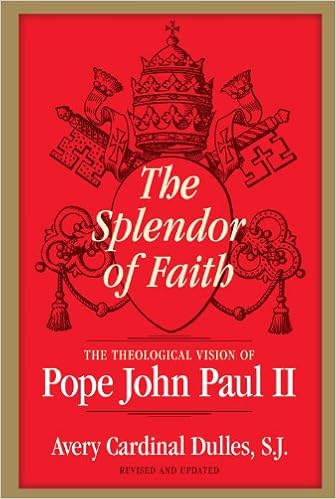
Here is an old review I wrote from a time when I was much more liberal than I am today. I suppose it might raise some Catholic traditionalist eyebrows. Given the crisis in the Church today, I understand their concerns.
However, whatever St. John Paul II’s failings, I myself cannot judge.
I can however give profound gratitude for everything this Saint of beauty DID achieve—of which this review gives but scant indication.
The review is also—as I say below —deliberately imbalanced to bring attention to lesser known aspects of St. John Paul II, so frequently buried in media myopia, if not outright viciousness.
An American friend of mine once remarked that most people’s impression of St. John Paul II amounts to little more than ‘pro-life, anti-communist’.
Now if one understands even a little of the Mission of the Church, the above perception indicates nothing less than tragedy on an enormous scale. Heartbreaking tragedy, as I consider all the implications involved in the millions of people believing in John Paul as representing little else, than simply being against abortion and communism …
For as important as the heroic undertakings of St. John Paul II in these areas undoubtedly are, his was a pontificate that can hardly be reduced to such a simplistic cartoon.
And it needs to be rendered visible how over twenty-six years, the papacy of St. John Paul II, addressed and rejuvenated innumerable dimensions of the Catholic faith, leaving countless numbers with a profound sense that they have witnessed one of the greatest, most overarching and far-reaching pontificates in the two thousand year history of the Papacy.
What is desperately needed then, is literature that testifies to the sweeping scope and enormity of John Paul’s mission. The sweeping scope and enormity … the more one studies and ponders St. John Paul II, the more one’s breath is taken away. Or at least, such is my own experience …
To this task, Avery Dulles’ book makes a most admirable beginning.
Clearly, Dulles focuses on John Paul’s thinking and teaching, rather than his vast legacy of decisive, pragmatic ACTION that has had such enormous geopolitical impact – including the Gandhi-like pacifist movement begun in 1950’s Poland by the future pope – then a simple priest – which would so alter the landscape of our world.
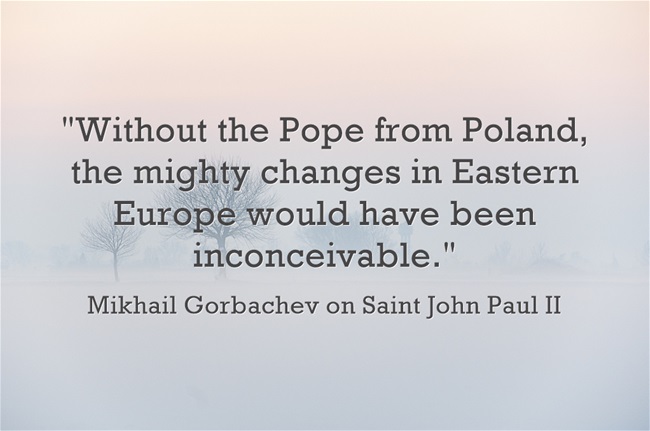
(For as Gorbachev said, “Without the Pope from Poland, the mighty changes in Eastern Europe would have been inconceivable.” But for that story, one will need books like Weigel’s Catholic biography Witness to Hope or Kwitney’s non-Catholic biography Man of the Century, which reveals John Paul both as a very human being, with both human shadows and human greatness.)
But here in Dulles’ book, what we get is not a focus on St. John Paul II’s vast legacy of direct action and initiative, but on his equally vast legacy of ideas. And as Dulles makes clear in highly accessible layperson’s language, the sheer scope of what John Paul addressed was truly STAGGERING.

Truly staggering then – once one gets beyond the media stereotypes – is not only St. John Paul II’s profound and personalist meditation on the Christian Mystery, but also its implications for our contemporary culture in countless regards: from economics to human rights, from ecumenism to the world religions, from war and non-violence, to secularism and epistemology, from gender and the ‘Theology of the Body’ … to how much else besides?
The list goes on … (How many people, for example, would credit the man who became St. John Paul II, with radically arguing for the importance of the female orgasm in 1950’s Poland?!).
And running like a golden thread of love through all of his profound thought, there is the dignity, the dignity of the human being, human freedom, human rights and EMBODIED human existence … the new dignity conferred to all of these through the Mystery of Christ.
There is so much more one can say about St. John Paul II’s scale of achievement. But this is a book review and not a book. I will simply leave the reader with a small sampling of the rich panorama, which Dulles’ book details in depth.
In the interest of integrity, I will also note that my very small selection is not without bias on my part. I am, as I have said, deeply concerned with the inherent tragedy and evil I see in smearing St. John Paul II’s legacy with nothing but a reductionist caricature such as ‘pro-life, anti-communist’.
The world deserves the truth and my own selection here is purposely made to balance the one-sided portrayal of the media. That said, here is a sampling of Dulles’ exegesis of St. John Paul’s thinking (which was clearly written during the late pontiff’s lifetime).
On matters of social order and economics, Dulles explores not only St.. John Paul II’s stringent critique of communism, but also of ‘capitalist neo-liberalism’ which as [St. John Paul II puts it ]
subordinates the human person to blind market forces and conditions the development of peoples on those forces. From its centres of power, such neo-liberalism often places unbearable burdens upon less favoured countries.
In explicating St. John Paul II’s social thinking, Dulles himself is worth quoting at length:
John Paul describes the devastating effects of consumerism in many of his encyclicals … In the consumerist culture, he says, the market is flooded with luxury goods that are acquired for purposes of amusement or as status symbols.
The rich are surfeited by a superabundance of possessions and enslaved by the tasks of managing and protecting their wealth. Meanwhile the poor are left in dire misery …
In accordance with his personalist humanism, St. John Paul II insists on the priority of labor over capital … Labor, while it should ideally redound to the benefit of the laborer as individual, has larger purposes.
It is intended also to benefit the family, the nation, and the universal human community.
Opposing the unbridled thirst for profits and power, St. John Paul II calls for a theology of development that takes account of the whole human person and every person. Authentic development, he maintains, must respect the cultural, transcendent and religious dimensions of human life.
In light of these broadly humanistic goals, it is possible to correct some of the errors of what the pope calls “economism” – a view that elevates enterprises only in terms of productivity and profits [Emphasis mine].
To turn to another set of issues, there is St. John Paul II’s rejection of authoritarianism in the Church. In this context, Dulles cites the entire legacy of St. John Paul II’s work, including his contribution to Vatican II, made while he was still a bishop from Poland.
The book makes clear then, the future St. John Paul II’s role in Vatican II’s thinking on religious freedom and how that has continued to be expressed in his teaching, quoting him as saying:
Religious freedom, an essential requirement of the dignity of every person, is a cornerstone of the structure of human rights …
The Church addresses people with full respect for their freedom. Her mission does not restrict freedom, but rather promotes it. The Church proposes; she imposes nothing [Emphasis in original].
Had the late Pope been simply the ultraconservative caricature, so often presented by the media, the Vatican II trajectory of freedom would have been negated – rather than reinforced.
Freedom, for true Christianity is all about freedom. It cannot be imposed. Yes, despite the countless tragic abuses that Vatican II has led to, people must be able to freely choose the Tradition. It cannot be imposed.
Speaking personally, I regret so, so much of what Vatican II has led to. But I cannot regret St. John Paul II championing religious freedom as integral to human dignity …
Yes, as Dulles makes clear to the unprejudiced reader, St. John Paul II’s papacy worked to extend Vatican II’s commitment to human rights and freedom.
Clearly related to the issue of religious freedom, is the matter of the salvific potential in other religions. Now in this context, a new thrust emerged at the Second Vatican Council, where major positive statements about other religions were made for the first time. And as Dulles makes clear, St. John Paul II continually re-emphasised the new approach of Vatican II in innumerable ways.
But at this point, I wonder if Dulles does not go far enough, when he writes that in the treatment of other religions, St. John Paul II … makes no doctrinal moves that clearly go beyond the council, but he does give an interpretation of the council that, at least in emphasis, is original.
In other words, St. John Paul II cannot be said to have definitively gone beyond the council – except in his emphasis, his emphatic call that is, to give honour to other religions. But my own feeling is that St. John Paul II’s teaching on the other religions is more radical than anything offered by Vatican II. For example, St. John Paul II has said:
Normally, it will be in the sincere practice of what is good in their own religious traditions and by following the dictates of their own conscience, that the members of other religions respond positively to God’s invitation and receive salvation in Jesus Christ, even while they do not recognise or acknowledge him as their saviour.
Thus, the head of 60 percent of global Christianity, decisively sheds the usual interpretation of Extra Ecclesiam non est Sallus (‘Outside the Church, there is no salvation’) by arguing the normal way for non-Christians is through their own religion. This seems to me, more decisive than anything said by Vatican II.
This of course raises the very serious question of what importance or value does Christianity have, if all religions can lead to Christ. This is a grave matter indeed, but St. John Paul recognised, I believe, that untold tragedy has been generated in the past by telling people that they – or their loved ones – were necessarily bound for hell if Extra Ecclesiam non est salus can ONLY mean “outside the institutional Church”. But St. John Paul II believe, did not want to negate the traditional teaching – so much as to make it more profound.
In regards to the matter of salvation, Dulles also draws attention to the controversy surrounding what may yet amount to one of the most groundbreaking positions ever held by any Pope.
For although it is not at all clear, there is evidence, that late in his life John Paul may have joined with Origen, John Henry Newman and Hans Urs von Balthasar in questioning whether in the end, hell will still be populated.
That is, though it is not clear-cut, St. John Paul II may have said:
Eternal damnation remains a real possibility, but we are not granted, without special divine revelation, the knowledge of WHETHER or which human beings are effectively involved in it (Emphasis mine).
Yes, if St. John Paul II did write these words, it would consolidate the view that may increasingly emerge of St. John Paul II in future years … a faithful traditionalist, faithful in this case, to the traditional Christian teaching of Hell, yet unwilling to condemn anyone to perdition or even to admit that human beings must necessarily be involved with it without the least hope of escape …
Coming from a modern secular perspective, this last quote may seem of small moment. Yet coming from a Pope dedicated to tradition, especially a Pope as beloved as St. John Paul, it could yet prove a momentous and evolutionary point in Catholic teaching …
Finally, in speaking of St. John Paul II and universalism, we should not ignore his transcendent Christology, which Dulles details admirably saying:
John Paul II takes every opportunity to quote Vatican II to the effect that Christ by his incarnation united himself … with every human being and in so doing elevated human nature to an incomparable dignity [and] points out ‘the incarnation of God the Son signifies the taking up into unity with God, not only human nature but in this human nature … the whole of humanity …
The incarnation then, has also a cosmic significance [Emphasis mine].
Oh, St. John Paul II. My review here is written partly to honour this worthy tome of your Cardinal, Avery Dulles.
He has written an invaluable, clear, accessible and necessary, most necessary book, that I profitably return to again and again.
But I confess that I also write this review to make a contribution to the veneration of your memory.
A world increasingly enthralled in ever more brutal social conditions, needs the unshuttered memory of your passionate, comprehensive and overarching vision of all that humanity …
(a humanity forever and irrevocably infused by the Christ, that is to say)
… yes all that humanity can be and needs to be, if we are not to sink further into the abyss …
Yes, if we are not to sink further into the social abyss generated by brutal, cold materialism, we need books like that of Dulles, which can open one’s eyes – and above all, one’s HEART – to all you tried to do, our dear and venerated John Paul the Great …
And to how our Church and World have forever been enriched beyond measure …
Foreword for Monarchy by Roger Buck


Buying Books at Amazon Through These Links Gives Us a Commission. This Supports Our Apostolate. Thank You if You Can Help Us Like This!
Comments
comments are currently closed
9 responses to “The Splendor of Faith by Avery Dulles (Review)”
[…] (Windswept House) (The New Faithful) (The Ratzinger Report ) (The Rise of Pope Benedict XVI) (The Splendor of Faith) (Salt of the Earth) (All the Pope’s Men) (Mother Angelica) (Ugly as […]
[…] (Windswept House) (The New Faithful) (The Ratzinger Report ) (The Rise of Pope Benedict XVI) (The Splendor of Faith) (Salt of the Earth) (All the Pope’s Men) (Mother Angelica) (Ugly as […]
[…] (Windswept House) (The New Faithful) (The Ratzinger Report ) (The Rise of Pope Benedict XVI) (The Splendor of Faith) (Salt of the Earth) (All the Pope’s Men) (Mother Angelica) (Ugly as […]
[…] (Windswept House) (The New Faithful) (The Ratzinger Report ) (The Rise of Pope Benedict XVI) (The Splendor of Faith) (Salt of the Earth) (All the Pope’s Men) (Mother Angelica) (Ugly as […]
[…] (Windswept House) (The New Faithful) (The Ratzinger Report ) (The Rise of Pope Benedict XVI) (The Splendor of Faith) (Salt of the Earth) (All the Pope’s Men) (Mother Angelica) (Ugly as […]
[…] (Windswept House) (The New Faithful) (The Ratzinger Report ) (The Rise of Pope Benedict XVI) (The Splendor of Faith) (Salt of the Earth) (All the Pope’s Men) (Mother Angelica) (Ugly as […]
[…] (Windswept House) (The New Faithful) (The Ratzinger Report ) (The Rise of Pope Benedict XVI) (The Splendor of Faith) (Salt of the Earth) (All the Pope’s Men) (Mother Angelica) (Ugly as […]
[…] (Windswept House) (The New Faithful) (The Ratzinger Report ) (The Rise of Pope Benedict XVI) (The Splendor of Faith) (Salt of the Earth) (All the Pope’s Men) (Mother Angelica) (Ugly as […]
[…] (Windswept House) (The New Faithful) (The Ratzinger Report ) (The Rise of Pope Benedict XVI) (The Splendor of Faith) (Salt of the Earth) (All the Pope’s Men) (Mother Angelica) (Ugly as […]