
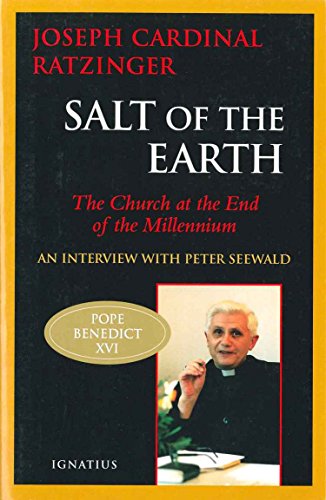
This book is essentially a lengthy interview that happened in the 1990’s with then Cardinal Joseph Ratzinger. And because it is an interview – rather than a theological treatise – it offers a remarkably accessible and easy reading of the mind and heart of the man who became Benedict XVI.
These days, this book will of course, be assessed by virtue of the fact that it sprang from the thought of the present Pope. And this is perhaps a shame, inasmuch as this is a great book, regardless of the author’s present office.
What constitutes its greatness? One notes the immense erudition here – the sheer breadth and depth of theological, historical, philosophical and psychological penetration on offer.
Yet these treasures are neither abstract, nor merely cerebral. Rather, they are filled with heart and feeling: it is apparent they have been acquired by a lifetime of intensely dedicated prayer, thinking and continuous practical effort on behalf of humanity, Church, and God – all of which the author clearly loves.
The commitment to the world is transparent in a very shrewd observation of the contemporary state of society.
Joseph Ratzinger emerges here as a man in recoil at the horror of “the dictatorship of relativism” and the horror he sees lying in its wake – an increasingly alienated, utilitarian and uniform society, stripped of meaning.
“An entirely planned and controlled society is going to be inexpressibly lonely”, the Cardinal once said, revealing also, I believe, his grave concerns about the political and corporate future of this world …
Though perhaps it is wrong to suggest that the Pope is in ‘recoil’. For what is evident here, is Ratzinger’s pragmatic and unswerving compassion, seeking to preserve the only real alternative he sees to a paradigm of deepening suffering and misery.
There is sharp insight here on a great number of fronts, from the failures of modern ideologies to the failures of the Church. Of particular relevance to the concerns of this website, there is also insight into the burgeoning New Age movement and its implications for the Church.
I was particularly struck by Ratzinger’s observation that, following a century of rationalistic reductionism in religion – dispensing with ‘angels and saints’ – there now
Comes a new impetus for the mysterious, and for a world … still somehow filled with the transcendent. And this includes, in fact, a new ‘angel craze’ that comes to us from outside the Church.
Similarly:
In a certain respect, a new age of religion has dawned … people are searching in a great variety of ways for religion, but don’t think they can find it … in the Church”. And that the Church appears to them, as only “a large apparatus … and institutional ballast that can’t be jettisoned, only because there is still some recognition of the ancillary function it performs.
Contrary to popular perception, Ratzinger calls the ‘over-institutionalizations’ of the Church a ‘scandal’ and indicates the need for Mystery and the need to represent the Christian Mystery to the world …
Yes although this book contains jewel upon jewel of insight, regardless of the author’s current status – there still remains great value to be had in realising that it represents the thought and heart of Benedict XVI.
This is particularly so in era when so many falsehoods and evils are levelled at the Holy Father. As I write this, I have before me words from the Financial Times, which tell us “Pope Benedict has … made clear that only those who find the Catholic way to Christ can expect salvation.”
This is false, one hundred per cent false. But gulled by the media, sincere and educated people can believe such travesties of the truth. Thus books such as this – which reveal the real Joseph Ratzinger – have all the more value.
In contrast to the infamous ‘God’s Rottweiler’ media image, a softer, pastoral side of Ratzinger is clearly in evidence here. For example, whereas the Cardinal Prefect holds “definitively [that] someone who has left the valid marriage … the sacrament and entered into another marriage cannot” receive communion, he nonetheless evokes a future possibility, whereby local and ‘extrajudicial’ determination might be made that no earlier sacramental marriage occurred.
Thus Ratzinger upholds Catholic teaching that valid marriage is Sacrament – a Sacred Mystery, rather than a social contract. At the same time, he also suggests that the possibility of understanding can be gained, without recourse to Rome, that certain Catholic marriages are not valid – that is to say, that a Sacred Mystery has not occurred.
In other words, we see here in the future Pope, a dual commitment – to the Catholic Mystery and to mercy, at one and the same time. For in the eyes of the Pope, it is a very modern, ultimately cynical idea that a valid marriage by the Catholic priest, involves anything less than a profound spiritual mystery.
It is not something that can simply be disposed of and thrown in the rubbish. Yet at the same time, there is also the unfathomable depth of truth to the words of the Master: “Blessed are the merciful …” (Mt. 5.7)
There is also a notable serenity here and lack of polemic. Whereas Ratzinger has been called an inquisitor by figures such as Hans Küng, I note what Ratzinger says of Küng, most sincerely, I think:
I respect his path, which he takes in accord with his conscience, but he should not then demand the Church’s seal of approval, but should admit that in essential questions, he has come to different, very personal decisions of his own.
The man who emerges in Salt of the Earth is, for me, very striking and very human. One can sense – again I say – a man who has dedicated his entire adult life to sincere prayer, to careful, painstaking thought and to profound – and often thankless – commitment to humanity and to God. One senses this total dedication of an elderly man, now at an age when many a man aspires only to peaceful retirement … a man who has now taken on a crown of thorns and is scourged by the world.
May this book, filled with the sobriety, the clarity, the kindness, wisdom and moral courage, garnered by a singular soul, who has dedicated his life’s blood in a way very few indeed of us could ever manage . . . may this book, I say, serve as an inspiration to pray for the soul of the Holy Father, as he carries out his lonely and vital office in a world of venom . . .
Foreword for Monarchy by Roger Buck
Buying Books at Amazon Through These Links Gives Us a Commission. This Supports Our Apostolate. Thank You if You Can Help Us Like This!
Comments
comments are currently closed
10 responses to “Salt of the Earth by Joseph Cardinal Ratzinger (Review)”
[…] (The New Faithful) (The Ratzinger Report ) (The Rise of Pope Benedict XVI) (The Splendor of Faith) (Salt of the Earth) (All the Pope’s Men) (Mother Angelica) (Ugly as […]
[…] (The New Faithful) (The Ratzinger Report ) (The Rise of Pope Benedict XVI) (The Splendor of Faith) (Salt of the Earth) (All the Pope’s Men) (Mother Angelica) (Ugly as […]
[…] But at the same time, it must be said such Traditionalists are frequently not facing the problem of the New Age. It is understandable – their attention is rivetted elsewhere: The tragedy that has happened to the Mass, the destruction of tradition, the danger of the Church becoming a “clone” of Protestantism (as the Holy Father acknowledged when he was still Joseph Ratzinger …) […]
[…] But at the same time, it must be said such Traditionalists are frequently not facing the problem of the New Age. It is understandable – their attention is rivetted elsewhere: The tragedy that has happened to the Mass, the destruction of tradition, the danger of the Church becoming a “clone” of Protestantism (as the Holy Father acknowledged when he was still Joseph Ratzinger …) […]
[…] (The New Faithful) (The Ratzinger Report ) (The Rise of Pope Benedict XVI) (The Splendor of Faith) (Salt of the Earth) (All the Pope’s Men) (Mother Angelica) (Ugly as […]
[…] (The New Faithful) (The Ratzinger Report ) (The Rise of Pope Benedict XVI) (The Splendor of Faith) (Salt of the Earth) (All the Pope’s Men) (Mother Angelica) (Ugly as […]
[…] (The New Faithful) (The Ratzinger Report ) (The Rise of Pope Benedict XVI) (The Splendor of Faith) (Salt of the Earth) (All the Pope’s Men) (Mother Angelica) (Ugly as […]
[…] (The New Faithful) (The Ratzinger Report ) (The Rise of Pope Benedict XVI) (The Splendor of Faith) (Salt of the Earth) (All the Pope’s Men) (Mother Angelica) (Ugly as […]
[…] (The New Faithful) (The Ratzinger Report ) (The Rise of Pope Benedict XVI) (The Splendor of Faith) (Salt of the Earth) (All the Pope’s Men) (Mother Angelica) (Ugly as […]
[…] *This image of the Catholic Church as Protestant clone can be found in Ratzinger’s book Salt of the Earth, which we have reviewed here. […]
[…] (The New Faithful) (The Ratzinger Report ) (The Rise of Pope Benedict XVI) (The Splendor of Faith) (Salt of the Earth) (All the Pope’s Men) (Mother Angelica) (Ugly as […]