
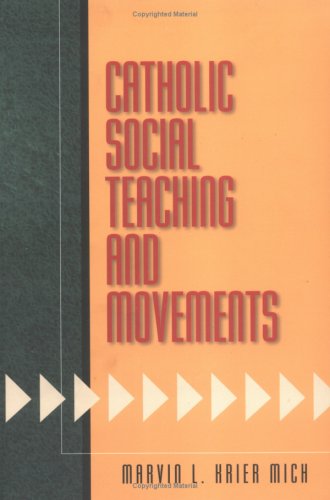
O Lord, what a mixture here of profound value, heart and beauty … and a frequent self-assured, polemical tone that, it seems to me, disserves the author’s sincere, heartfelt intent.
Let me begin with the gold. The author cares, the author obviously cares about our world.
Thus his book can serve to open one’s heart to the terrible, terrible suffering of the victims of third world poverty, war, racism, unbridled capitalism and other contemporary evils.
This is to say, reading it, our sleeping hearts may waken a little to the tragedy and horror that real people are really experiencing – every moment of our lives.
Mich’s compassionate concern for those who really suffer commands the deepest respect.
Joined to this, is his most thorough, well researched account of the last hundred and fifty years of Catholic response to social injustice. Mich’s expansive, inclusive approach embraces both the Vatican’s official teaching – and the many great figures of the lower clergy and laity who have often served to inspire the Popes.
His vivid writing brings a long forgotten history of heroic souls alive. He begins with the great nineteenth century Catholic figures who initially responded to the horrors of emerging capitalism, which led to the Papacy confronting the problem head-on.
And in like fashion, he continues through the twentieth century: skillfully interweaving grassroots Catholicism, with the great Papal documents challenging capitalism, poverty and more.
The great Papal documents so few seem to know about, so often offering profound thinking and carefully considered alternatives …
If Mich is very good on the history of Catholic thinking and action regarding social injustice, his consideration of the future is also often penetrating. Moreover his grasp not only of the the global crisis – but also the economic, political, cultural, environmental dynamics at its root, is often acute. One can learn a great deal indeed from this book.
It is with deep regret then, that I turn to a less commendable aspect of Mich’s otherwise very fine effort. I have in mind here, an editorializing tone that is frequently disingenuous.
Basically a set of opinions Mich holds about the Vatican – which of course he has every right to hold – is subtly presented as though they were not opinions, but rather facts – plain, straight facts, without nuance, without ambiguity.
To me, there seems to be little consciousness here as to why Catholics of a different persuasion might reach different conclusions to Mich. Thus, if the more traditional approach of the Vatican falls foul of Mich’s view, its various efforts amount to `useless’, `a crass violation’ and so on – and are reduced to Vatican power politics and `phobia’. And like so many others, Mich speaks of these matters as though they were simply facts to be accepted.
One particularly disingenuous example of what I mean occurs in the treatment of Liberation Theology. In a question for discussion given at the end of his chapter, Mich encourages readers to ponder
Why did the Vatican controlled leadership [of a Latin American conference] reject the experience based method of liberation theology and substitute a method that begins with the … official … teachings?
But this is disingenuous inasmuch as, throughout the chapter, Mich never allows any other view than his own to surface!
The reader who does not know better can only answer the question the way Mich answers it. And Mich’s answer boils down to this: the Vatican acted as it did out of fear and power-hunger. And apparently nothing else.
But there are other possible explanations. After long consideration of the matter, I am convinced of the aching heart of Bl. John Paul II and Cardinal Ratzinger who, like Mich, really cared.
And I am convinced they were certain that third world agony would not be helped by throwing out the baby with the bathwater … That liberation theology would be stronger with a living, faithful Catholicism, rather than without it.
My point is that the facts deserve deeper consideration than simply writing the Vatican off – as though it were just power-crazed. And that was that. Sadly, I suspect this is what Mich sincerely believes – as do millions of other sincere, caring Catholics who have not penetrated the immense compassion of a man like Bl. John Paul II.
Yes, it is also true that Mich has many fine things to say about present Vatican policy – WHEN he agrees with it. Thus, for example, he deeply commends the Vatican’s condemnation of modern capitalism and war.
It is only where he disagrees, that nuance, ambiguity and discussion disappear. When Mich disagrees, the Vatican is suddenly reduced to an ogre. Or so it seems to this reader.
This is sad, indeed. But it does not diminish the fact that this book is also filled with real heart, admirable scholarship, comprehensive documentation of the world’s suffering and the response of the entire Catholic Church.
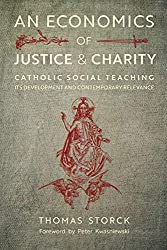


Foreword for Monarchy by Roger Buck
Buying Books at Amazon Through These Links Gives Us a Commission. This Supports Our Apostolate. Thank You if You Can Help Us Like This!
Comments
comments are currently closed
2 responses to “Catholic Social Teaching and Movements—Marvin L Krier Mich (Review)”
This is an excellent review and spot-on. I used it in a college classroom for its enormous strengths. I stopped using it because my more informed students couldn’t get past the ”tude” in some spots and began dismissing all of it. Really a shame. It’s an unusual and great synthesis of grassroots and hierarchical Catholicism in most of the book.
IC – thank you so much for this.
Yes the attitude as you say is sometimes so patronising as to be hostile to aspects of the Church’s teaching that the author disagrees with – to the point of distorting reality, in places at least.
There may well be readers of this somewhat traditionalist site who will not be able to comprehend how I could – with reservations – possibly recommend a book like this.
But I have learned by trying to listen to a wide variety of voices in the Church from liberal to very traditional.
Too many in the Church I think only listen to the people that they already agree with. I do not agree with Mich on many things, but nonetheless I learned a great deal of real value from his “great synthesis” as you put it.
Thanks again!